Working Groups / Hydrogeology and geotechnical engineering
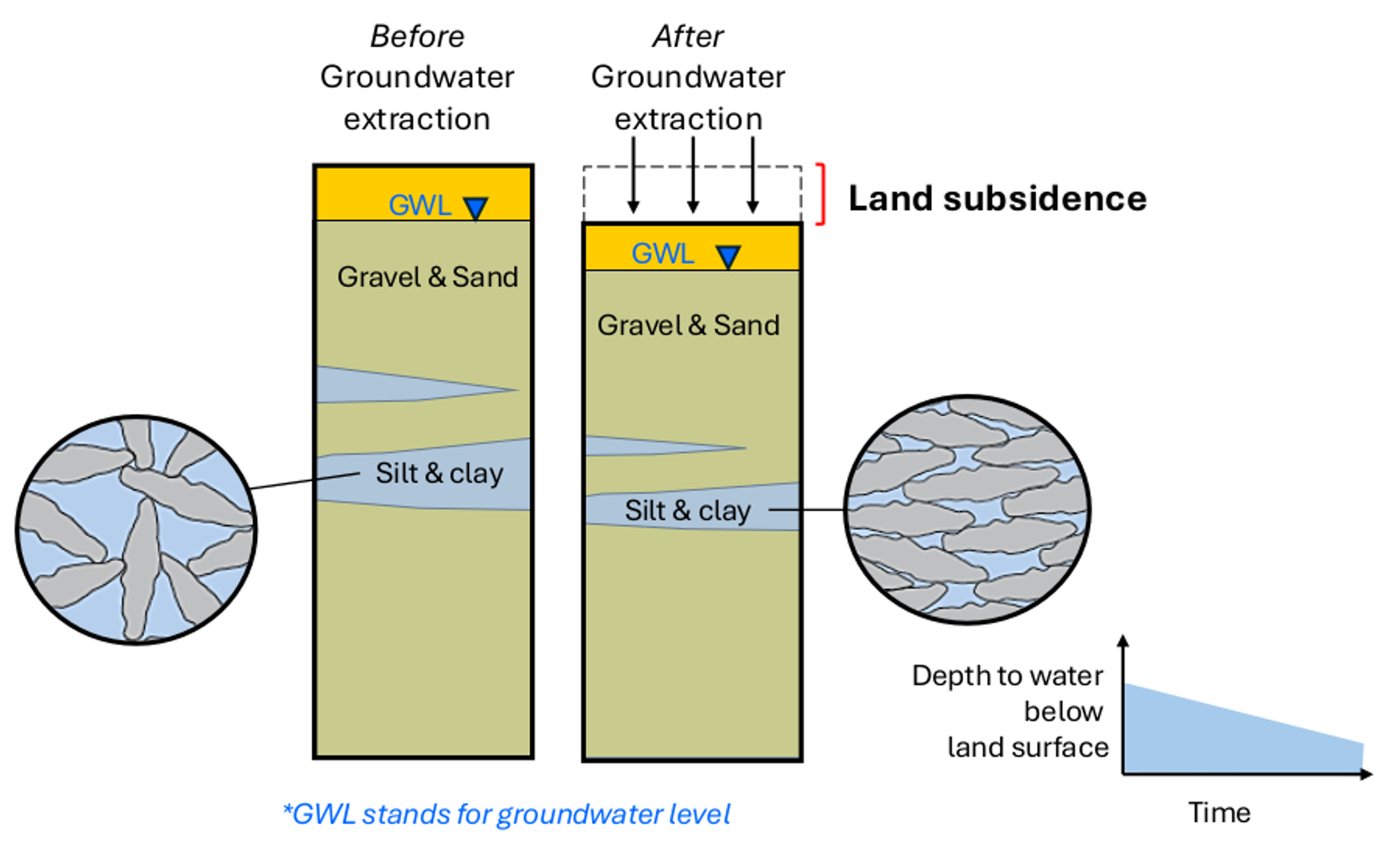
Groundwater extraction can induce land subsidence through the compaction of susceptible aquifer systems, typically unconsolidated or poorly consolidated alluvial aquifers composed of alternating sequences of permeable aquifers and low-permeability aquitards. The reduction in pore pressure induced by groundwater withdrawal increases the effective stresses on the sediment granular matrix, with compaction effects primarily affecting the aquitards. Such variations in the stress state activate processes with response times ranging from years to decades, sometimes resulting in a permanent reduction of the pore volume and aquifer storage, with direct implications for the future availability of groundwater resources. These processes alter the hydrogeological and geotechnical behavior of the system, increasing vulnerability to future changes in withdrawal and recharge and compromising long-term water balance. The growing pressure on subsurface resources, driven both by climatic changes and by increasing water needs due to demographic growth, exacerbates these issues. Hydrogeological characterization of aquifers and assessment of the geotechnical response of soil mechanics, with particular attention to interactions between natural processes and human activities, are therefore essential to predict land subsidence evolution and to define strategies for sustainable groundwater management and mitigation of geotechnical risks to infrastructure.
Members
-

Roberta Bonì (Coordinator)
-

Michela Marchi (Coordinator)
Bibliography
- Bonì, R., Meisina, C., Teatini, P., Zucca, F., Zoccarato, C., Franceschini, A., ... & Herrera, G. (2020). 3D groundwater flow and deformation modelling of Madrid aquifer. Journal of Hydrology, 585, 124773.
- Bonì, R., Cigna, F., Bricker, S., Meisina, C., & McCormack, H. (2016). Characterisation of the hydraulic head changes and aquifer properties in the London Basin using Persistent Scatterer Interferometry ground motion data. Journal of Hydrology, 540, 835-849.
- Marchi, M.; Bertolini, I. & Gottardi, G. (2024). Endangered historic sites: the case study of Santa Croce in Ravenna (Italy). Geotechnical Engineering Challenges to Meet Current and Emerging Needs of Society - XVIII European Conference on Soil Mechanics and Geotechnical Engineering, ECSMGE 2024, Lisbon, London, CRC Press, 2024, pp. 1209 – 1213.
- Bonì, R., Herrera, G., Meisina, C., Notti, D., Béjar-Pizarro, M., Zucca, F., ... & Mora, O. (2015). Twenty-year advanced DInSAR analysis of severe land subsidence: The Alto Guadalentín Basin (Spain) case study. Engineering Geology, 198, 40-52.
- Bertolini, I., Gottardi, G., Marchi, M. & Ugolini, A. (2023). Cultural heritage and subsidence: the emblematic case study of Santa Croce in Ravenna (Italy). X International Symposium on Land Subsidence – living with subsidence, Delft-Gouda, 17-21 April 2023 pp. 31 – 35.